
On Terminology and RPGs

The semantics of a technical endeavor are crucial to its success. In an environment where a misunderstanding ultimately means “getting it completely wrong”, we must suffer over the elaboration of every term so that no ambiguity1 remains.
In the realm of RPG discussion, it is evident that the prevailing body of terminology serves to confuse rather than to clarify. For an outsider peering into the field, the experience is seeing numerous deployed contradictions and a continuous semantic warping, indicating two important points:
The median experience in the field is (unconscious) persistent confusion. Full initiation into RPGs (apparently) either requires swimming in contradictions or gaining access to some esoteric corner where the “real” field can be discussed.
The field must be, on some level, Technical Enough(TM) that it requires care with respect to terminology and language. Otherwise, this widespread fog of confusion wouldn’t exist; simple “natural” language would be enough to clarify any point.
Why did this happen? How can it be remedied?
The Choice of Two Systems
For our purposes here, outlooks on the construction & deployment of terminology can be split into two broad competing approaches: self-descriptive terminology vs. identifying / indicating terminology.
Self-descriptive terminology (SDT) characterizes a concept by highlighting its key facets in the label. Its utility is obvious; it lends transparency to a term’s invocation, allowing rapid initiation into the discussion by eliciting the reader’s intuition and his exposure to common knowledge. Just by saying the term, the audience gets a feel for its meaning.
Examples of SDT include iterative development (“a workflow that proceeds by successive iteration”) and password (“a word that allows you to pass”).
Alternatively, identifying / indicating terminology (IIT) does not characterize its concepts. It employs a unique label—with no embedded explanation or further elaboration—to indicate a precise, singular notion. Each terminological label is a map to a well-defined concept or conceptual “region” in the same way that a bar code maps to a single identifiable product.
Examples of IIT include Newtonian mechanics and Mixolydian mode. The elaboration of these terms could fill text to dwarf this article. However, practitioners which use them not only understand what they mean but also benefit from the clarity provided by the boundaries these concepts establish (such as Newtonian vs. relativistic vs. quantum mechanics).
To get straight to the point: the RPG arena has suffered tremendously under the strain of self-descriptive terminology. Why is that, and how could a consideration so niche have such a significant impact?
Fatal Downsides of SDT
Self-descriptive terminology (SDT) is attractive in the current “Content Age” when every access point to the internet is concerned with fighting over the attention of prospective users2. Because SDT terms are transparent and serve to (at least partially) explain themselves, this mode is a clear winner in these contexts. The user is onboarded and included in the discussion with minimal resistance.
By contrast, identifying / indicating terminology (IIT) offers immediate resistance to most readers. Invoking unknown terminology will bring a reader to a dead stop or leave them scrambling for context, with no ultimate solution provided other than to look up and slowly conquer the elaboration of the term elsewhere.
Ambiguity
The obvious downside of IIT is its impenetrability. But the major downside of SDT is ambiguity, leading to differences in received / inferred meaning. SDT’s reliance on the elements of the term to be self-explanatory is a non-starter for subjects with rich characteristics, exceptional cases which violate intuition, surprising properties, or complex second- and third-order effects.
Let’s take a concrete example from RPGs: roleplaying game. (Of course, we have all seen this before and know what’s coming.) If we read this in the SDT framework, we can define it as “a game where you are playing a role.” This definition has been invoked verbatim in countless discussions in the RPG arena. By this definition, it is easy enough to conclude that not only is the video game Diablo a roleplaying game but also that Starcraft, Monopoly, all Solitaire variants, and Real Life3 are all roleplaying games.
Given that the RPG arena is.. the arena of RolePlaying Games, this is quite obviously a severe foundational problem. Some readers may think this example is cherry-picking or unfair, or perhaps too silly to take seriously. Observe the eminent and brilliant Steve Jackson making a complete fool of himself:
(excerpt from “My Life and Role-Playing”,
originally published in 1979 in Different Worlds #2)To begin with, most people who are reading this probably cut their gaming teeth on a role-playing game, years and years ago. The most popular board game ever developed in the US is pure role-playing. Yes . . . Monopoly. Consider: each player takes on the role of a cheerfully rapacious real-estate tycoon…
… A role-playing game is one that invites its players to take on a personality different from their own. …
…
Case in point: my own first design, Ogre, was a role-playing game. … One player takes the role of the Ogre … a gigantic, nearly unstoppable, murderously-armed killing machine of incredible power. … The defender, too, has a role to play. …
There are many, many examples of terms which have suffered from ambiguity in the hobby, and their presentation is just as groan-inducing—and just as damning.
Evolution of Meaning
English, especially, is a language of great adaptability and fluidity. With access to both Latin- and Germanic-derived grammars, roots, and phrasing customs, it is the tendency of English terms to shift meaning with each generation—the Great Wheel turns and a different spoke points to the sky.
If we look at a term like password, it seems so simple that it has to be proof against this problem. However, consider the evolution of the password over time. At first, it was “kodiak” or maybe “YourName5”. Then, because those proved insecure, it became “xc8Q9yT)” and similar examples, already losing the -word relation. Then “password managers” made it into an obscure horror a hundred characters in length. Then biometrics4 made our thumbprints into a password. Now, the most common password in the world is.. a picture of one’s face. The utilization of the concept evolved until it became divorced from the SDT interpretation of its label.
Where SDT terms are subject to (highly unpredictable) evolution of meaning, the IIT terms like Newtonian mechanics surprisingly have even more advantage against this danger than they do against ambiguity. The reader resistance which we judged so painful is precisely what prevents these terms from being wielded with the same lyrical abandon as SDT terms. The fact that the elaboration—which is a hard requirement for IIT terms—is some large cache of knowledge in a textbook, or perhaps a whole bookshelf, makes it impossible to shift very far in meaning.
Hit Points
This is a favorite example of mine because the term had already evolved into nonsense even before D&D was put to print. In the days before roleplaying was part of the game design discussion, we can see many wargames based around the concept of a Hit. If a unit took a Hit, it was typically Destroyed or would become a Casualty or would otherwise be taken out of play.
But what if we had a really big, tough ship? Would a single Hit really be enough to take it down? This question plagued early designers who were looking at relatively small gunboats downing a capital ship in one shot (or similar examples). There was some experimentation with saving-throw-like effects, but the prevailing solution was to say that the big ship could sustain multiple Hits—and its Hit Points specified the number of Hits it could take.
But what does the term Hit Points mean now? “The amount of damage something can sustain before dropping into a lower-agency state.” But what is the typical understanding of damage now? “The amount of Hit Points a successful Hit reduces the target by.” It became a circular and somewhat silly web of terms!
Note that we could define damage as “the number of Hits a successful attack generates,” and it would completely fix this—but that ship sailed long ago.
Laziness & Motivated Reasoning
A second-order effect of relying on the SDT framework to describe our hobby is that a simple lack of virtue or absence of good-faith approach is all it takes to destroy any discussion. This pattern allows the lazy, dishonest, and opportunistic to frame the conversation in whatever way they please.
Malefactors will approach an honest attempt at discussion and, instead of treating a piece of terminology holistically, dissect each term to separate it into its distinct linguistic elements. From here, they will place their own interpretation on the pieces before assembling them back together to arrive at an entirely different meaning than was intended.
Participants seeking honest discussion have no recourse against these tactics. If we are interpreting every term as SDT, we are constrained by the fact that it is implicitly self-explanatory—any interpretation that is not grossly misaligned (and some that are!) becomes validated by the license inherent in the ambiguity.
For this reason, a broad and open endeavor relying on an SDT framework will inevitably lead to confusion. Not just personal confusion—in the sense of misunderstood or misapplied knowledge—but widespread mass confusion. Drowning the entire endeavor in confusion. Suffocating discussion between participants with noise and nonsense.
Braunstein as the Basis
The central concept in BrOSR projects—the one which is presented as foundational to roleplaying—is Braunstein. When researching the BrOSR and its methods, EnragedEggplant presumed that BrOSR must be a portmanteau of Braunstein and OSR, a fitting conclusion which has been retroactively adopted.
Conceptually, Braunstein is the umbrella under which every BrOSR discussion or concept is contained.
In this light, consider the example of roleplaying game and how the SDT framework destroys its utility almost on contact. How would the IIT framework fix this problem?
The alternative proposed by the BrOSR is functionally substituting roleplaying game with Braunstein5.6 As of the time this post was published, almost no one knows what Braunstein means. But if the operative definition—“multiple independent actors operating in conflict under a fog of war”—is available and applied to roleplaying game, it would be very difficult to morph this meaning into something else.
If it has
multiple independent actors (i.e. they are free to navigate the imagined Second World without arbitrary restriction)
the true possibility of conflict (i.e. the arena in which they operate is an open conflict space, ready for the full spectrum of diplomacy)
a maintained fog of war (i.e. a per-actor perspective on information)
then it is a Braunstein; but if it is missing any of these elements, it is not!
By providing the first operative definition of Braunstein—“multiple independent actors operating in conflict under a fog of war”—Jeffro Johnson may have unintentionally become the first person to concretely define something fundamental to the roleplaying activity. Before this definition, the only answers anyone could provide to “what is a roleplaying game?” were
elaborate manifestos that retreat into non-sequiturs and inevitably collapse into a personal aesthetic philosophy
tautological or semantic-replacement “definitions” playing off the name (thanks, SDT!)
“dungeon delving with my friends” et al
Make-Believe with Constraints (the most coherent, but still insufficient, answer)
How do we decide whether this concept, the Braunstein, is fundamental? How do we know whether the given definition is useful, or even coherent? Exploring these questions is the path that the BrOSR took since the release of BROZER, and this concept and its definition have proven to be immensely clarifying forces.
Focus and Delineation
If the RPG arena were to become defined as “the hobby in which participants set up and play Braunsteins,” then we have not merely relabeled an existing conceptual space but have delineated a new and much more precise space. Let’s temporarily label the current RPG arena the Getalong Gang Hobby (GGH) and the newly defined arena the Braunstein Hobby (BH).
The GGH has a vast membership right now, but the conceptual space it occupies is relatively small—we see designers pressed up against the edges of it, gasping for air as they search for something else to do in the space. On the other hand, the BH has a very small current membership, but the conceptual space is dramatically larger and richer than GGH. Importantly, there is almost no overlap between these hobbies (a major point in Winning Secrets).
The First Real RPG Typology
In the landmark publication BROZER: Island of War and Winter, we see the first ever coherent, systematic, and precise RPG typology ever put to paper—though the author was almost certainly unaware of this at the time.
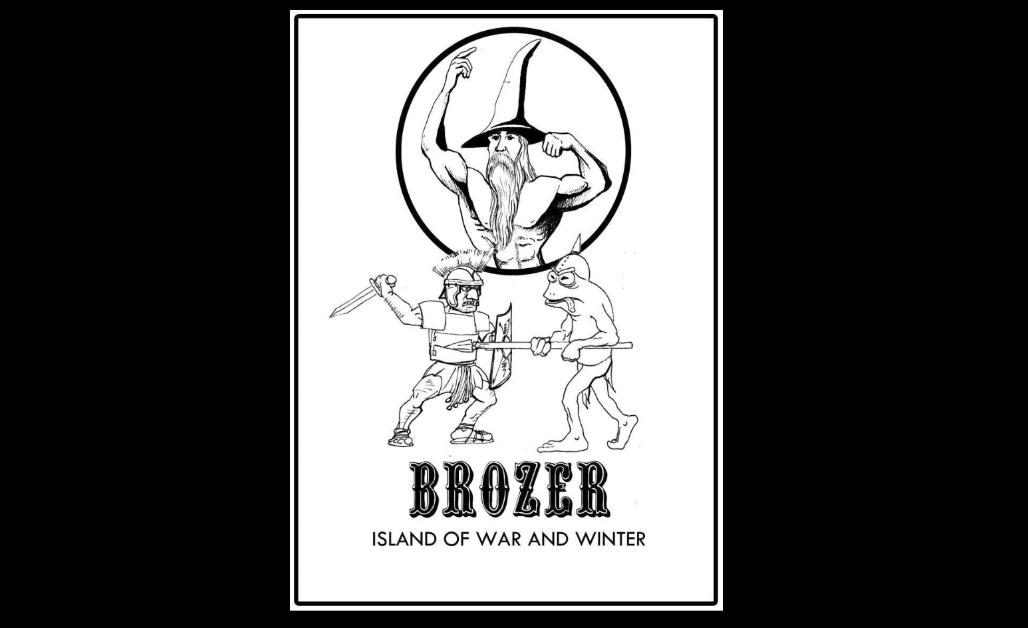
In the essay entitled “Running Your First Faction Braunstein” in BROZER, Jeffro Johnson defines three “approaches” to Braunstein play in an attempt to explain to the reader how they might begin and organize their own game. These became known later as Type I, Type II, and Type III Braunsteins. A follow-up publication by Bdubs1776, UMBROS: A Braunstein of Dinosaurs and Treachery at the Earth’s Core, would add Type IV.
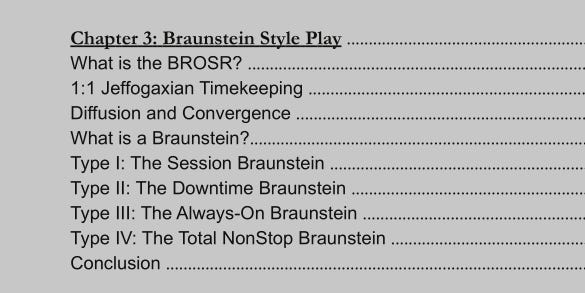
Each member of this typology was derived from experiment7 and presented in experiential terms so that new readers / players could adopt the methods to try for themselves, but—on reflection—the explanations for each type obviously define a unique method by which a Braunstein gets spread out over time.
The Type I–IV system, to someone armed with the definition of Braunstein—someone who knows that “campaign” means “a Braunstein spread out over time”—condenses and sorts a complex swirl of ideas into a clear four-way distinction based on four different relations to timekeeping.
This process of mining additional clarity & utility from a set of defined terms can only happen if some underlying phenomenon works according to principles captured (at least in part) by those terms. The Braunstein concept is clearly real and accessible, and the operative definition provided for it is clearly mapping out at least some of its characteristics.
The Resistance “Problem”
Let’s be blunt: it will be very difficult to explain to Grandma how to participate in our Type II Braunstein without elaborating all the underlying concepts being invoked by that term. For this same reason, the Braunstein conceptualization of RPGs is not something that will catch on like fire and consume the hobby in a month.
But if even a genius like Steve Jackson can get tripped up by something as basic as flawed terminology, then the question of whether to relax the required level of precision is already answered for us: without a rigorous approach, everything we’re working on would eventually morph into nonsense, and any realizations which seem important might later be revealed to be nothing at all. For the sake of those who come after, and for the sake of those attempting to understand, we must ultimately have a precise, unflinching terminology to which all developments are surrendered and recorded.
Consider a concept like SEEN8. If someone says, “I get it; whenever you see another player, you make a rumor,” they can be corrected because the term does not conform to natural language such that someone could get away with introducing this confusion.
The resistance aspect is crucial here. It allows the higher echelons of BrOSR experimenters and builders to rapidly assess and iterate on things without getting carried away into folly. Meanwhile, onlookers can absorb the terms and perform their own experiments and find their own way into these higher echelons without any direct mentoring or other “initiation” process required—this is the strength of a clear and unflinching terminology.
Thank you for your readership! Primeval Patterns thrives on the basis of the sincere interest and support of hobbyists like you.
Liked the article? Some other interesting things:
Read Winning Secrets to unlock the deepest understanding of RPGs.
Follow the author on X.com (formerly twitter).
Check out BMD, a far-future wargame-infused TTRPG about slaughtering aliens.
With work, we can achieve TTRPG Supremacy!
If you are a true fanatic, take the oath of battle and become a paid subscriber here on Substack. This directly supports the war effort (and the development of BMD plus the design research on this blog.)
BONUS: paid subscribers can read extensive BMD development blogs and will receive a PDF copy of BMD!
Even if the field is later revolutionized or reimagined, the given perspective delivered should be unambiguous given the fundamental working assumptions of the previous iteration.
There is a deeper and more pervasive reason that self-descriptive terminology has won the hearts of modern denizens: an undercurrent of obsessions with “efficiency” leading to the degraded notion that is (falsely) named “elegance.”
I guess it depends on how much of a gamer you are.
Biometrics are very bad passwords, by the way! They should be treated more like usernames.
“But that doesn’t distinguish between David Wesely’s landmark experimental game design and the generalization of the principles discovered as a result of it not running the way he envisioned.” Well, that seemed to concern neither Wesely nor Arneson nor anyone else in their scene because they casually refer to e.g. Banania as “a Braunstein,” and Blackmoor was referred to as “a medieval Braunstein.” Credit: Griff Morgan
Actually, we still need a label for The Thing That Has Developed—the forced-cooperation Getalong Gang sometimes-game—in the absence of the Braunstein conceptualization of RPGs. “Conventional play” won’t last forever…
Type IV is different because it was posited by Bdubs1776 as a possibility, and he set about with play experiments to uncover its workings. I think that technically makes him the world’s first theoretical RPG scientist.
See The Destruction of Drakonheim for a brief overview of the SEEN system.
The Tower of Babel has yet to be overcome, but in striving to overcome its curse, there is no condemnation.
It’s an unlikely event it seems at times such as these that communication ever occurs.