
Wrestling With Proteus
Establishing a Theory of Campaign Management

In the course of setting up a campaign, running sessions in its gameworld, and otherwise carrying out interactions between its elements, we proceed on the basis of many unspoken assumptions. Despite potentially being the source of and explanation of divergent approaches to RPG play, these assumptions have gone largely unarticulated.
When should random encounters be deployed, and when are they invalid? Where does the distinction between “oracular” dice and mere randomness lie? What is the basis for judging whether a ruling was appropriate?
Surprisingly, the search for clarity on the aforementioned assumptions directly reveals the answers to these—and many other—questions.
Herein, we provide the inaugural example of an unambiguous framework for running RPG campaigns. Developing this framework follows a simple process: we establish a premise about the gameworld, explore the consequences of that premise, and build a procedure that allows us to coherently maintain it, guaranteeing its validity.
Both the framework itself and the process of arriving to it reveal that these unspoken assumptions involve divergent conceptualizations of a campaign’s gameworld. While valuable in the analysis of campaign management circumstances, the framework’s practical importance is quickly overshadowed by the implications of its structure & form. Embedded in the framework, we find insight into deep philosophical questions—with subjects ranging from logical consistency to causality—that have lain without a satisfactory answer since the dawn of the RPG hobby.
The Knowable Gameworld
The key starting point is an operative premise: the instantiated gameworld in which the campaign takes place is a true and, in principle, fully realizable Second World. Maintaining the validity of this premise will power all of our important findings. In essence, the campaign manager and the players participating in the campaign adopt an epistemic commitment1 to treating the imagined gameworld as if it were a real place.
This premise uniquely harmonizes the motivations & thinking of players and the characters they control because, with only a trivial reframing, it is shared between players and characters. The characters absolutely believe (and are axiomatically enabled to believe) that the Second World is a real and realizable place. At the same time, the players hold absolute trust in the veracity and integrity of the gameworld (because both are strictly maintained) and know that any decisions they make on behalf of characters2 will be made within a logically coherent framework that is guaranteed to be valid within the gameworld itself. In simple terms, the character view of the gameworld from “below” is exactly aligned with the player view of the gameworld from “above.”
Elements within the gameworld behave according to its Fundamental Laws, and no campaign event which would violate those Fundamental Laws could be considered valid—in gameplay terms, the event could not have happened. Things which happen (or cannot happen) in the gameworld adhere to a strict internal consistency in such a way that contradictions cannot result. This is true regardless of who is running a gameplay session or who is managing the campaign as a whole.
An inescapable conclusion, then, is that as the gameworld accumulates campaign canon, it becomes more authoritative than any person involved in its management. It necessarily follows that the aspects of the ruleset (i.e. the game manuals and other formalized rules that govern gameplay) which impact how the gameworld is structured are similarly more authoritative than the participants.
Campaign Canon
Our central focus is the concept of campaign canon: the events or circumstances that are known to have happened in the gameworld. Note that the Knowable Gameworld premise is not a guarantee in this schema; rather, it is operationally a requirement that forms constraints on how we proceed. As we will demonstrate, the implied constraints apply chiefly to the process of accepting or rejecting specific interpretations of campaign canon.
An important implication of the Knowable Gameworld is that logical processes like deduction and inference must be valid when applied to its campaign canon (given the ruleset). This is the formal consistency requirement (usually left implicit herein) that will be the basis for building our campaign management process.
Interpreting Uncertainty
Among the many requirements implied by the Knowable Gameworld premise is that all outcomes of game procedures must be interpretable as facts about the gameworld. This has dramatic consequences on our understanding of the rules and our attitude towards them.
Prime Example: Encounter Systems
In many RPG contexts, the activity native to an environment is presented through a “random encounter” system. In these systems, we construct a table of fitting results, each with an assigned probability. We navigate these probabilities through dice rolls, conventionally, to end up with a basis for a concrete encounter in the gameworld.
The widespread approaches to random encounters are muddled across many dimensions of unarticulated considerations. A complete elaboration of this point would be too extensive a distraction from our present goal, but we can understand the muddled thinking by comparing the attitudes and tendencies presented over arguments for (or against) them at the point of contact.
What responses do we see to the proposed scenario of rolling an encounter at the table during a session? They vary greatly:
“This is the way the game should be played.” (A preference for organic introduction and, perhaps, the “fairness” of surprise.)
“This is completely normal / unextraordinary.”
“The game would be infeasible to run without the encounter system.” (This suggests it is a sort of pragmatic compromise, with implied costs weighed against the benefits of continuing play.)
“Rolling for encounters shouldn’t be done during the session unless there is no fallback option.” (Random encounters viewed as a purely emergency method to save us from ill preparation.)
“Making random things up during the session is ‘slop gaming’, lacking in any appropriate vision or harmonious presentation.” (Openly hostile towards any “true” randomness getting a say in the gameworld, preferring a curation filter.)
Each of these reactions (and their nuanced families of sub-reactions) indicates a different presumption about what a gameworld is and what place it holds in the grand scheme. But for our purpose, we can see that the Knowable Gameworld premise requires that we interpret random events and circumstances presented by gameplay not as noise or disordered variance but rather as strictly factual, harmonious additions to campaign canon; each random outcome must be seen as one element of incomplete data, the full set of which would form the larger underlying picture of the campaign.
Broad Requirements on Rulesets
To reiterate, the Knowable Gameworld premise requires that anything which results from the game’s rules must be treated as factual. Thus, the encounter systems are not interpretable as “random encounters” but as a means of discovering what was truly present in that time & place in the gameworld3.
Additionally, it is an unavoidable imposition on the ruleset that every possible outcome of game procedures must create facts which are inherently consistent with the gameworld; otherwise, simply playing the game would eventually result in a violation of the Knowable Gameworld premise.
There are two families of responses to this problem.
First, we could create some external criteria with which to review and curate outputs from the game procedures. This criteria can conceptually exist above both the ruleset and the gameworld—acting as a filter for both—or we could selectively apply it to merely the ruleset, affecting the gameworld only indirectly.
Second, we could proceed with a forced conclusion that the facts provided directly by the ruleset—or facts resulting from the outcomes of the ruleset’s procedures—are necessarily internally consistent. This is essentially “faith in the ruleset4” and is equivalent to the presumption that a coherent interpretation of any ruleset-derived fact exists.
Note that the first family of responses can be reframed to “modify the ruleset into a new formalization, creating a new ruleset” and that the second family of response is a necessary ultimate destination, after implementing such a solution. It follows that any ruleset which cannot achieve the presumption of coherent interpretations is necessarily invalid for maintaining the Knowable Gameworld.
Resonant Deduction
Since the Knowable Gameworld is the foundation for instantiating and sustaining our RPG campaign, we require a ready means of ensuring that the preconditions for its validity do actually exist5 and are in place at all times. For this purpose, we present a systematic framework6 in the form of a game procedure, the structure of which has interesting properties and reveals some surprises while simultaneously providing unexpected clarity on many topics.
Important Terms
Our process centers around the deployment and interplay of two major concepts: apophenia and abductive reasoning.7
Apophenia is a cognitive process where an observer perceives an unjustified relationship between two observed events C and D. For our purposes, it can be understood as follows:
1. C is observed.
2. D is observed.
3. Capriciously, a link ‘L’ between C and D is imagined.
For example, if we see “a cat ran out of the garage” and “a paint can is spilled in the garage,” we might capriciously imagine that the cat knocked the paint can over.
It is important to emphasize that the link ‘L’ is not inferred or otherwise justified by any rational process; step 3 is an imaginative, creative step. For completeness, we allow that the link ‘L’ could be “none”, i.e. the decision that C and D are merely coincidental.
Abductive reasoning, though formally ill-defined and ambiguous, is the process of seeking a propositional explanation for an observed event. For our purposes, it is best to understand abductive reasoning as:
1. A surprising event P is observed.
2. A set of envisioned prerequisites X = [H, I, J, …] is conjured for P.
3. A selection criteria measured across X prefers the explanation H, thus
4. H is the best of available explanations of P, thus
5. Propositionally, H.
For example, we observe that “the cat knocked over a paint can in the garage and dashed out”. We imagine several possible stories that could lead to this outcome, choosing one with supporting explanatory facts that accord with the observed event: “the cat chased a mouse across a workbench and collided with a paint can; its impact against the floor startled him, and he dashed out of the garage”. The selection criteria applied across our potential explanations allowed us to conjure the presence of a mouse and workbench in this example; other selection criteria will create different restrictions on the parameters of our explanation.
Initial Sketch
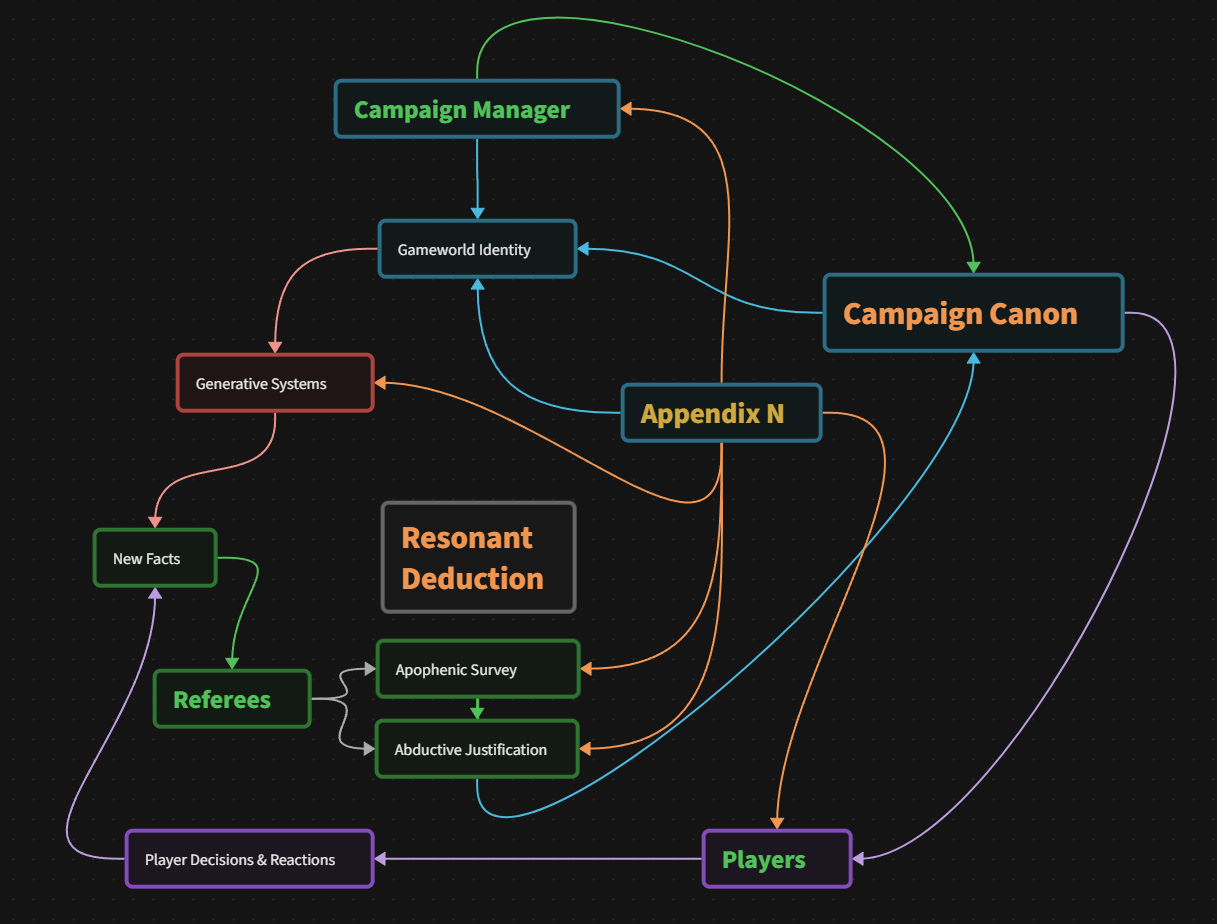
Our specific process of running the campaign—a process that successfully maintains the Knowable Gameworld premise—we will name Resonant Deduction. It follows the steps:
Wait until a new fact ‘p’ is introduced into the campaign.
If ‘p’ has a logically necessary explanation H, then H is formally added to campaign canon. Return to step 1. Otherwise, continue to step 3.
An Apophenic Survey is performed, wherein a new campaign canon event K, incorporating ‘p’, is proposed.
An Abductive Justification of K is performed. If rejected, return to step 3. If accepted, K is formally canonized into campaign canon, along with its explanatory precursors. Return to step 1.
By managing the campaign in this way, each fact introduced by player intervention, gameplay mechanics, or the natural consequences of events set in motion becomes absorbed into campaign canon as a canon event. The (sometimes random) events and circumstances presented by gameplay are interpreted as incomplete data that we are continuously accumulating to understand the big picture.
Each movement through the cycle creates a new factual anchor from which we can infer further facts. These facts accumulate—with each revealed fact clarifying the “space” around it in the fog of war—until large parts of campaign canon are well understood. In this way, we are gradually “deducing” the full picture of the campaign across the full timeline of its relevant history.
Apophenic Survey
Since the Knowable Gameworld premise requires that we envision our gameworld as (in-principle) fully realizable, our broader concept of the gameworld becomes that of a vast ignorance about the campaign with a few important well-known anchor points of data. The Apophenic Survey acts as a way of (creatively) interpolating between revealed data points, essentially acting as a guess about the structure of unknown data in a local vicinity.
Formally, this works by following the process:
Apophenic Survey
1. A surprising fact ‘p’ is observed.
2. Given campaign canon S, characterized by canon events[A, B, C, … J],
3. Capriciously, a link ‘L’ between ‘p’ and one or more elements of S is imagined.
4. This link constitutes an event K.
In plain language:
A new fact (‘p’) is observed about the campaign—one which must be incorporated into the campaign as a valid addition (K) to campaign canon (S). We perform an Apophenic Survey, which is essentially asking “Given the known campaign canon, characterized by events [A, B, C, … J], how does the new fact ‘p’ fit in?” It may be the case that ‘p’ is related to an established campaign event (in which case, K would be conceptualized as an addendum or modification to that event) or that it signals some new thread thus far unexplored (in which case, K is an independent event).
Example Apophenic Survey
‘p’ = “the locked & barred door to an abandoned church basement is covered in blood”
S = [“mid 1800s ‘New England’ setting”, “a merchant opportunity requires an experienced sailing crew”, “the PCs paid for a colleague to visit several port towns looking for crew”, “the colleague disappeared”, “the PCs followed his trail to Harburton”, “unfriendly, evasive locals”, “one of the PCs went missing the day before”]
Capriciously, the referee decides on K = “a violent cultist kidnapped the colleague”.
Notable qualities spring forth from seeing this process in action.
First, it is clear that only a campaign manager or well-prepared referee will actually have the fullest knowledge of S (the campaign canon as established thus far). His position with respect to the Apophenic Survey is thus superior, but that does not prevent the players from participating or offering up their own suggestions based on their subordinate knowledge of S.
Second, even though the process is fundamentally capricious, it is clear that the mechanism for imagining the form of K must either be a deliberate invocation of some literary canon or will necessarily be an unconscious invocation of a similar variety (i.e. the invoker’s personal “literary canon”). The campaign’s “Appendix N”—whether explicitly spelled out or not—finds its way into the action at this step.
Third, the choice of K will impact the next step. Even without prompting, we have a strong tendency to approach K with a stance of broad coherency. Constructing plausible scenarios from newly encountered facts is something we already do when navigating a campaign as a player—we are trying to infer the truth of the campaign state. Using this exact same muscle, as a referee or campaign manager, when deciding upon explanations for encountered facts is a natural pivot.
Abductive Justification
The proposal generated by the Apophenic Survey is, in principle, irrationally motivated. If the proposal were true8, it would imply an array of facts; any implied facts contradictory to revealed campaign canon must invalidate the proposal. Abductive Justification, from this point of view, has the function of rationalizing the proposal, imbuing it with explanatory power while also harmonizing it with campaign canon.
Formally, the process is:
Abductive Justification
1. A surprising event K is observed.
2. A set of envisioned precursors X =[H[x], I[x], J[x], …]is conjured for K.
3. A selection criteria measured across X prefers the explanation H[x], thus
4. H[x] =[H1, H2, H3, … ]is the best of available explanations of K.
5. We define K* =[H1, H2, H3, … K]and add it to established campaign canon S =[A, B, C, … J]to get an updated campaign canon S* =[A, B, C, … J, K*].
The precursors in step 2 represent a set of events H[x] = [H1, H2, H3, …] that account for the necessary prerequisites for K to be true.
Selection Criteria
The selection criteria in step 3 implicitly—and necessarily—include the criterion of causal consistency, ensuring that the additions K* = [H1, H2, H3, … K] are non-contradictory with the established campaign canon S = [A, B, C, … J]. This non-contradiction check fulfills our formal consistency requirement—an important consequence of this is that, in principle, character suspicions could have predicted the form of K*.
Aside from causal consistency, the campaign manager may choose to implement a variety of criteria for the precursors. As an illustrative example, a campaign manager may choose to define a Least Necessary Intervention criteria, seeking an explanation that requires zero or minimal interventions by agents in the campaign. If our surprising fact ‘p’ is “Bob’s party encountered a dragon in the forest,” then K* might be “Bob’s party encounters a dragon who has lived in this forest for years and makes his lair there.” This is in stark contrast with a K* = “a nearby wizard opened an experimental portal in this forest, and a dragon came through, eventually running into Bob’s party.”
Criteria for explanations of K might center on a notion of plausibility or be motivated by an aesthetic vision or thematic structure we might wish to extract from a source literary canon—Appendix N comes into play here once again.
Because the choice of precursors is subject to a selection process, and their nature is inherently explanatory, the selection step can be understood as a rationalizing step; we take the irrationally motivated K and apply explanations H[x] = [H1, H2, etc.] to arrive at a holistic picture that harmonizes the new event such that its presence results in a more coherent campaign canon than its absence.
Example Abductive Justification
Recall our earlier example.
‘p’ = “the locked & barred door to an abandoned church basement is covered in blood”
S = [“mid 1800s ‘New England’ setting”, “a merchant opportunity requires an experienced sailing crew”, “the PCs paid for a colleague to visit several port towns looking for crew”, “the colleague disappeared”, “the PCs followed his trail to Harburton”, “unfriendly, evasive locals”, “one of the PCs went missing the day before”]
Capriciously, the referee decides on K = “a violent cultist kidnapped the colleague”.
Our K is a violent kidnapping by a cultist. We must envision precursors which act as establishing facts—events which would have to be true, by necessity, to explain the truth of K. One such precursor, H[x], might be:
H1 = “a secret cult operates among the townsfolk in Harburton”
H2 = “the cult is working on some horrid plan or ritual”
H3 = “the colleague stumbled onto some indication of the cult’s plan”
H4 = “the cult kidnapped (and potentially killed) the colleague to prevent their plan from being widely exposed (e.g. to a police force with the means to stop them)”
We combine these facets into a K* by incorporating the explanations:
K* = “while scouting Harburton for experienced sailors, the colleague stumbled onto the presence of a malign cult who kidnapped him to prevent their plan from being exposed”
Analysis of Resonant Deduction
Let’s summarize our work so far.
Our axiomatic rule is to maintain the Knowable Gameworld premise: the instantiated gameworld in which the campaign takes place is a true and, in principle, fully realizable Second World.
The process by which we maintain the validity of the Knowable Gameworld premise is Resonant Deduction:
Wait until a new fact ‘p’ is introduced into the campaign.
If ‘p’ has a logically necessary explanation H, then H is formally added to campaign canon. Return to step 1. Otherwise, continue to step 3.
An Apophenic Survey is performed, wherein a new campaign canon event K, incorporating ‘p’, is proposed.
Given campaign canon S, characterized by canon events
[A, B, C, … J],Capriciously, a link ‘L’ between ‘p’ and one or more elements of S is imagined.
This link constitutes an event K.
An Abductive Justification of K is performed. If rejected, return to step 3. If accepted, K* is formally canonized into campaign canon, along with its explanatory precursors. Return to step 1.
A set of envisioned precursors X =
[H[x], I[x], J[x], …]is conjured for K.A selection criteria measured across X prefers the explanation H[x], thus
H[x] =
[H1, H2, H3, … ]is the best of available explanations of K.We define K* =
[H1, H2, H3, … K]and add it to established campaign canon S =[A, B, C, … J]to get an updated campaign canon S* =[A, B, C, … J, K*].
Convergence & Diffusion
If Resonant Deduction is the engine that drives the campaign forward, the surprising fact ‘p’ is clearly the fuel. Every time a ‘p’ is produced, Resonant Deduction eats it; as a result, the campaign lurches forward by one step. There are some interesting qualities in this dynamic.
For the sake of clarity, we will call the introduction of a surprising fact ‘p’ an injection.
Even though it may be hard to define, it is clear that there are superior and inferior varieties of injection. Since the campaign “advances” with the incorporation of each injection, we can understand broadly that after a large number of injections, the campaign has “moved” to a conceptually different place. But what characterizes a “good” place vs. a “bad” place for our campaign to land?
A Tale of Two Campaigns
Consider an experiment beginning with a single, consistent campaign manager overseeing two separate campaigns, both starting with campaign canon S characterized by events [A, B, C].
After a month of play, the two separate campaigns have been transformed by a large batch of injections.
In campaign X, we have S = [A, B, C, D, E, F, G, H].
In campaign Y, we have S = [A*, B, C*, D*], with a ‘*’ indicating that the original event has been added to or modified in some way.
In campaign X, the outcome of player actions could be characterized as the accumulation of unrelated events. In campaign Y, by contrast, the outcome of player actions was the focused development of existing canon.
In BrOSR parlance, the injections in campaign X have resulted in diffusion, while the injections in campaign Y resulted in convergence.
A New Perspective on Convergence & Diffusion
In the diffusion-derived canon, we end up with a larger space of independent events. Arguments have been made that this is a necessary development for a campaign to achieve convergences. From comparing the two campaign canons, we might entertain the metaphor of a larger field being capable of yielding a larger crop, resulting in a larger chance for truly excellent specimens.
However, the development in campaign Y not only directly resembles convergence—without the implicit requirement for additional injections to achieve a payoff—it also has other advantages which Resonant Deduction makes plain.
When we perform an Apophenic Survey, we must envision a link between our injection and our existing campaign canon. When we perform an Abductive Justification of an injection-derived event, our envisioned explanatory precursor events must be formed such that they are harmonious with existing campaign canon. Both of these tasks become much more computationally difficult as the raw extent of campaign canon grows.
Each addition of a causally independent event is akin to increasing the dimensionality of campaign action—essentially, each independent event represents a distinct thread of action and/or activity unrelated (by the most up-to-date interpretation) to all others. Whenever an injection is fielded, the campaign manager is ultimately deciding to which thread of activity that injection will be related, including a potential (causally independent) new thread.
Something remarkable happens when a campaign manager reaches the Abductive Justification stage: he has the opportunity to collapse unrelated events into one thread of activity.
Consider campaign canon S = [A, B, C, D, E, F, G]. The campaign manager fields an injection and ultimately ends up with the explanation that the injection unifies events B and G.9 Our new campaign canon becomes S = [A, B*, C, D, E, F].
Diffusion increases the dimensionality of action in a campaign by adding independent events. Convergence decreases dimensionality of action by unifying once-independent events.
When we are engaging in diffusion, our campaign is stalling. The injections are powering our engine, but we’re driving in ever-widening circles, arriving nowhere. When we are engaging in convergence, the campaign is actually getting somewhere; it is forming a broad identity as the elements within it become developed—the nature and form of their interrelations begins to exhibit a life of its own. This formation of a campaign identity is an irreversible act; our campaign travels down a path to the exclusion of all other paths—a key indication that the motion is real.
Game Design for Injections
Since mass convergence is the desired ultimate outcome for a campaign, it follows that large swathes of game design should be oriented towards providing the right structure to produce injections which lend themselves towards convergences.
Every time we ask the game a question by rolling on an encounter table, determining reaction, filling out a hex, or so on, the answer comes in the form of an injection. Everyone in a position to impose immutable constraints on a campaign has some control over these injections.
First, every gameworld descended from a given ruleset will have defining assumptions and principles. A campaign manager (or a player, under his direction) may augment these assumptions with further elaborations. For example, the presence of a dragon may be commonplace and relatively “mundane” in one environment, while in another it may be an apocalyptic event. This method of control has a vast scope, the details of which would divert from our present focus.
Second, the game systems can directly influence the form of injections. Whenever a player performs some activity that is within the explicit umbrella of a game system, the player only controls the inputs to that system; the designer—whether he is the rulebook writer or is otherwise imposing structure on campaign play—is the one who fashions the outputs.
In recent years, the innovations in conceptualizing campaigns have led to the GOSS and SEEN campaign management systems, both of which affect the form of injections in unique ways.
GOSS
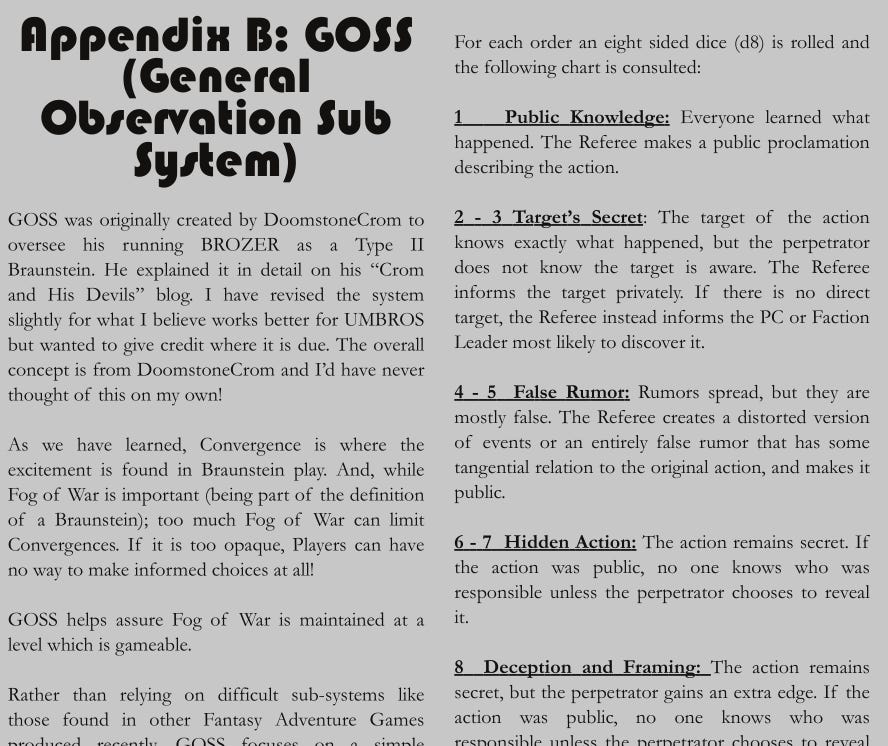
Popularized in UMBROS: A Braunstein of Dinosaurs and Treachery at the Earth’s Core, GOSS10 is a powerful framing tool designed to ease the management of Braunsteins. With the Resonant Deduction process made plain, we can see where GOSS does the heavy lifting.
Example
Curtis the ranger notices signs that indicate a thief is staking out his secret lair in the forest. His player declares to the campaign manager his intent to set a trap and ambush the thief. Some dice are rolled when the thief returns, and Curtis kills him. The thief turns out to have been a beloved local hero Thordane, a fighter. A GOSS die is rolled, and a ‘1’ signifies that the killing was public knowledge—word will get out that Thordane was killed and that he died as a result of Curtis’s ambush.
Let’s reformulate this summary from Curtis’s perspective into a full Resonant Deduction analysis from the campaign manager’s perspective11, beginning with the campaign canon S and the newly introduced fact ‘p’.
S = [“Curtis the ranger lives in the forest”,
“Curtis has a secret lair in the forest where he accumulates rare ingredients”,
“Thordane the fighter is a local hero”,
“Badok the alchemist is the village doctor”,
“Badok secretly poisoned Thordane and ‘saved’ his life with a curative”,
“Badok demanded that Thordane acquire Curtis’s rare ingredients to settle the life debt”,
“Thordane was planning to find and rob Curtis’s secret lair”,
“Curtis suspects someone is attempting to rob his lair”]‘p’ = “Curtis set an ambush for a thief and killed Thordane”
Setting up this example provides a concrete conceptualization of the fog of war: each character in the campaign—and, by extension, their controller—has only a limited understanding of S. For every element in S, each character will have some degree of knowledge of that element. In this example, neither Curtis nor Thordane have knowledge of Badok’s plotting, and only Thordane has any idea about Badok’s desire for the rare ingredients.
In this case, ‘p’ has a logically necessary explanation already: H = “Curtis killed a thief stalking his lair and discovered it was Thordane”. Because the circumstances and motivations behind all actions are clear, it appears there is no need for either Apophenic Survey or Abductive Justification.
However, the GOSS roll demands that the killing becomes public knowledge. We could treat this demand as a new fact ‘q’ or we could recognize that the GOSS result acts as a modification to our explanation of ‘p’. We move from
H = “Curtis killed a thief stalking his lair and discovered it was Thordane”
to something like
K = “Curtis killed a thief stalking his lair and discovered it was Thordane; the incident became public knowledge”
From here, we proceed with the Abductive Justification of K as normal. We conjure different families of explanatory events (X = [H[x], I[x], J[x], …]) that address how the incident became public knowledge. Choosing from among one family of explanations, we arrive at K* = “Curtis killed a thief stalking his lair and discovered it was Thordane; a hunter happened to witness the killing and spread word of it”.
Thus, we can see that each different variety of GOSS result can be viewed as modifying the event associated with the new fact to include requirements about managing the fog of war or, to put it in more detailed terms, tweaking the degree of per-character knowledge about an event about to be canonized.
SEEN
Using the same example, we can analyze the mechanism of SEEN12 to understand how it differs from GOSS. The basic requirement of SEEN is that every consequential campaign activity must have some public information attached to its outcome—and that the form of this publicizing is the responsibility of the player who ordered the activity. This means that when players are formulating in-world schemes, they are already considering how their activities will appear to the world at large and by what manner information about those activities will find its way into the public consciousness.
Because our analysis centers around the new fact ‘p’ = “Curtis set an ambush for a thief and killed Thordane”, we perform a Resonant Deduction analysis with only the limited perspective of Curtis. Rather than using the full campaign canon S we use a viewpoint-limited subset13 of S as follows:
S_limited = [“Curtis the ranger lives in the forest”,
“Curtis has a secret lair in the forest where he accumulates rare ingredients”,
“Thordane the fighter is a local hero”,
“Badok the alchemist is the village doctor”,
“Curtis suspects someone is attempting to rob his lair”]
We already have a logically necessary explanation for ‘p’ in the form H = “Curtis killed a thief stalking his lair and discovered it was Thordane”. But SEEN requires that consequential campaign outcomes must, to some degree, leak to the public. Therefore, SEEN is again a modification on our event, leading to
K = “Curtis killed a thief stalking his lair and discovered it was Thordane; word leaks out about the incident”
Note that with SEEN, the form of our information leak is not set; it is determined by the player14 responsible for initiating the activity (or in some cases by another involved player if e.g. the initiator’s character had died in a confrontation).
We send our K through Abductive Justification. The set of explanatory precursors (X = [H[x], I[x], J[x], …]) is different in two ways. First it is conceptually larger since the form of the information leak is not constrained by a process like GOSS. Second, it is conceptually much less complex because Curtis’s player has access only to a limited subset of campaign canon S with which to harmonize the explanations. In this way, we can see that SEEN is a transformative rule that modifies the very nature of Resonant Deduction by offloading its most complex steps into the realm of player responsibility rather than campaign manager responsibility.
To continue out the example, the player chooses a selection criteria over the families of explanatory precursors, ending up with a final K* = [H1, H2, H3, … K]. An example K* might be “Curtis killed a thief stalking his lair and discovered it was Thordane; a worried friend of Thordane’s found his body next morning”.
The corresponding SEEN post might be:
Local village hero Thordane has been found slain by a malicious trap! The ranger Curtis, known for haunting the local woods, is nowhere to be found! The sheriff has posted a notice with a warrant for his arrest.
Simulationism & Braunstein
The Knowable Gameworld premise requires that our gameworld can be treated as a fully realizable Second World, in principle. The exceedingly important in principle qualifier ensures that we are not required to provide an explicit model of all of reality; rather, we presume that a suitable model exists and is in accord with transcendental principles we implicitly invoke.
On both a pragmatic and conceptual level, our premise is a clear invitation to a simulationist ruleset and approach. Many gameplay-relevant “mundane” considerations are circumstantially necessary for a gameworld to be treated as a “real” place, specifically:
Systems of value that reveal the relative opportunity costs of common goods & services, facets like structures or vessels, rare items such as magic tomes or advanced technologies, and so on.
“Energy” costs that reveal what is difficult vs. what is easy (and their relative degrees) in the gameworld. How long does travel take? How much do rations cost to buy vs. produce? How much manpower and funding is required to run a keep vs. a farmstead vs. a raiding fleet?
The nature of different places in the world. To what degree does disease and general hardship keep populations out of the swamp or the wasteland? What advantages are there in the forest vs. the coast?
The structures of power and influence. Is rulership determined by might, magic, or technology? Are the established powers in a stable stasis with one another, or is politics a delicate balance?
Addressing these families of questions grounds the campaign world in a way that allows for clear and precise player reasoning which will necessarily be aligned with character reasoning—the magic of simulationism! From here, the value or impact of less mundane facets becomes clear, e.g. the costs of a teleport spell vs. the costs of a travel expedition.
Framing the campaign as a Braunstein, multiple independent actors operating in conflict under a fog of war, is also strongly supported by the Knowable Gameworld premise. Recall that with a small pivot in perspective, the premise is shared between players and characters. Characters believe that the Second World is a real and realizable place, whereas players believe in the veracity and integrity of the gameworld for the purposes of fair adjudication, player reasoning, and general coherency of action & response.
In much the same way, the characters in the Second World are undeniably engaged in a “1:1 time” Braunstein with & against the other characters that inhabit that world—full-spectrum diplomacy, with all under an umbrella of inherent competition, exists simply by the invocation of the Knowable Gameworld premise. By employing the exact same pivot in perspective, players approaching the campaign as a continuous Braunstein achieve another dimension of perfect alignment with their characters.
In this way, attempts to maintain the Knowable Gameworld premise reveal a natural closeness and alignment between simulationism and the Braunstein conceptualization of RPGs.
The conflict threat at the core of a Braunstein must be enabled with a well-defined quantitative foundation, both for its resolution systems and for the circumstances surrounding the clashes that can come about during the course of a campaign. If players cannot reason over the opportunity costs of various diplomatic moves and stances, then both the modes of conflict and the instantiations of those modes become ethereal—questions of power & advantage become abstract, and the impetus for conflict becomes hazy. Without certain well-defined anchors for reasoning, players lose the ability to understand their character’s situation and thus lose the ability to competently play their character’s role. The conflict core loses its power and meaning!
A Braunstein diminished and demoted in this way loses the inherent qualities attributed in its definition and effectively ceases to exist as a Braunstein.
For the gameworld to be realizable, it has to be real (according to our epistemic commitment). It has to operate on principles we take for granted in our own world, with causes leading to effects and inputs affecting outputs. To the extent that simulationist design captures things working “how they would work” in our gameworld, simulationism and Braunstein are inextricably linked.
Simulationism & Abductive Justification
One surprising relationship between simulationism and Resonant Deduction is that simulationist design philosophy appears to be maximally enabled only via Abductive Justification.
When we have a propositional event to add to campaign canon, we peer into matters related to that event. We envision potentially many explanations—as well as the precursors necessary to canonically justify those explanations. Simulationism is practically presumed to be at work in this step! Next, we select from among those envisioned explanations, choosing one to enshrine as campaign canon. This process implicitly invokes simulationism because we are seeking an explanation necessarily grounded in the systemic qualities of the gameworld (even if it happens to be an exceptional case within that systemic framework).
Interestingly, from the other side of the coin, the mere existence of Abductive Justification in our campaign management process serves to legitimize a zealous simulationist approach without requiring a burdensome excess of rules to account for all of causality. When we ponder over candidate explanations, the fact that we begin with the answer lets us resolve many questions (most notably, “mundane” questions) without the need for an explicit mechanical basis. Working backwards from a conclusion allows us to infer a gameworld’s manifold systemic processes without ever needing to know their exact shape or specifications.
This is a remarkable concept which we will elaborate on in a later section.
On Rules and Rulings
During play the referee is often merely relaying facts about the gameworld to the players. However, occasionally he must make a decision—from the viewpoint of the Knowable Gameworld premise, essentially an educated guess—about what happens in a particular circumstance that does not fall under the guidance umbrella of any extant game system.
In such cases, there are two general approaches for him to take15.
Labyrinthine: His decision about the outcome becomes enshrined into a rules addendum and will forever canonically be part of that campaign’s rules as an addition. This approach accumulates interpretations of specific matters into a monolithic and binding tradition via generalization. Asymptotically, we approach a multi-layered, all-encompassing structure from which there is no escape.
Protean: He declares that the question he’s ruling on is so particular and unique to a precise configuration of circumstantial details that no one should interpret his decided method as precedent for future activities. This approach treats each such ruling as a one-off, implying that generalization would be improper. Asymptotically, we orbit around a foundational ruleset that defines the presumptions of the gameworld and offers constraints on rulings only indirectly through applied interpretation of descriptive systems.
On a practical level, most RPG design efforts combine these two approaches across different game elements. In order to draw valuable conclusions about their nature with respect to Resonant Deduction, we must consider them in their most distinct relative stances.
At present, the majority of serious analysis in the RPG sphere would consider the Protean approach to be a lesser (e.g. perhaps incomplete) form of the Labyrinthine approach, leaving the rules Labyrinth construction as the only family of methods16 faithful to logic. Indeed, if we were to “poll” all RPG play (including the very bad), we would find that this prevailing interpretation has much evidence to its credit. On the surface level, only the Labyrinth has the appearance of aspiring to the kind of coherency that the Knowable Gameworld premise naturally requires.
Nevertheless, we will make the case that the Protean approach to rulings is not only sound but superior.
Fundamental Differences
The Labyrinthine approach takes the stance that knowledge of the gameworld should ideally be received in some overarching cosmic sense. The game-runner navigates the Labyrinth, according to methods outlined by the most learned and wise navigators, until he finds an unexplored path where the answer lies; he records that new path, then relays that answer to enlighten the players. When confronted with his past rulings, a Labyrinthine game-runner need only retrace his steps to support the legitimacy and correctness of his decision.
The Protean approach, by contrast, presumes that knowledge can be imposed upon the gameworld from unexplained & unaccountable, and perhaps inaccessible, reaches. When a circumstance arises where the rules do not indicate a precise path forward, the game-runner makes a prophetic “prediction” of a scenario’s next step. He is, in a literal sense, exercising creative license within the general constraints set by the gameworld’s nature and the specific constraints set by the campaign canon. When confronted with his past rulings, a Protean game-runner will evade objections of inconsistency, insisting that the form of each circumstance is imbued with sufficient uniqueness to validate his creative, rather than deterministic, approach.
Labyrinthines will discuss whether the right answer was arrived at, whereas Proteans are only concerned with a right answer.
Fitness with the Knowable Gameworld
Both approaches are compatible with the Knowable Gameworld premise for very different reasons.
The Labyrinthine approach implicitly presumes that the gameworld has an immutable, cosmically correct description across its full history. The gameworld would be a near-deterministic object, if we had perfect knowledge of the following:
the gameworld’s initial state
the mentality and approach (across time) of all players
the ownership or stewardship of every character with respect to the players, at each point in time
the (time-evolving) nature of “unmanned” characters, as received from the Labyrinth
In a ruleset with no outcome variance (i.e. no dice-rolling or other infused randomness), we would have a completely deterministic system. In practice, none of these elements can be completely known, and the joy and purpose (at least, in part) of gameplay is the process of filling in the blanks.
Regardless, the Labyrinthine approach explicitly fulfills and maintains the Knowable Gameworld premise.
The Protean approach operates in a fundamentally different way. The gameworld’s past, present, and future are considered to be in “cosmic” flux until the hammer of fate drops. The topology of knowledge is marked by small pockets of revealed truth surrounded by a vast, opaque veil of ignorance. In this environment, any event which is coherent with the game rules and with established truths could come to pass. These dark regions of ignorance represent opportunity—the possibility of strange unknowns forcing their way into campaign affairs. The fundamental indeterminacy of this cosmology is what the Protean game-runner leans on to make his prophetic “predictions.”
In the Labyrinthine approach, the gameworld’s history is like a puzzle, with each piece belonging in a specific place and orientation in the timeline; we fill in the puzzle by playing. In the Protean approach, the known aspects of the gameworld’s history are like a construction of LEGOs. Play reveals new pieces—previously swirling in the void of the unknown—which can be placed in a number of different ways, with potentially many orientations, depending on how campaign canon has evolved. In both cases, the premise is upheld because the imagined Second World is realizable to whatever extent desired, and its known parts will always fit together in a self-consistent manner.
However, the clear point of contention in this comparison is the general coherency (or lack thereof) of the Protean approach.
Systemic Effects Demand Answers
Consider the space of all possible campaign interactions split into two considerations: the rarity of encountering the interaction and the degree of inherent systemic quality in the interaction. We have four broad categories:
Rare & Low System
Frequent & Low System
Rare & High System
Frequent & High System
Labyrinthine
From the perspective of building towards the Labyrinth, these four categories are listed in order of increasing priority for systematizing. We can imagine discussions among different factions of Labyrinthines on the necessity of (fully) mapping pathways for each category, but it is clear that cases in 3 and 4 will elicit strong consensus towards an explicit system, with many arguing for cases in 2 as well. Cases in 1 would be the most susceptible to compromises, based on subtle argumentation we’ll leave aside for the time.
Protean
In categories 1 and 2, the interactions are imbued with high variability or otherwise fail to conform to predictable, parametric outcomes. In category 3, the rarity of encountering the interaction (arguably) dampens the relevance of its systemic quality; any apparent contradictions from differently directed rulings can be attributed to incomplete knowledge of circumstances.
Environments that fit into categories 1–3 are “inherently Protean” in the sense that unconcern about contradictions downstream from (relatively) free-wheeling rulings is implicitly justifiable or, more conservatively stated, has a clear basis for justification.
In category 4, however, we will inevitably build contradictions if we do not have coherent systemic rules ready to address these interactions. In any particular circumstance, we can simply imagine how things would coherently work. But over the course of 100 such circumstances, even small deviations would result in many contradictions across the whole—the campaign canon comes under fire.
The “safety” and surety of the Protean process breaks down in category 4. We can conclude, then, that the Labyrinthines may declare total victory over this category. Thus, it is clear what the Protean demands from the ruleset: that, at minimum, all High Frequency + High-System phenomena must be addressed explicitly in the rules—otherwise, the Protean approach fundamentally breaks down.
A Justified Imposition
There are two interrelated reasons that the Protean approach is sound.
The first reason is that Resonant Deduction as a process is inherently Protean in its production of campaign canon. In fact, a less dry-sounding name such as Protean Campaign Management would be fitting for Resonant Deduction. It relies on the same underlying philosophical web of coherency as a Protean game-runner making a ruling on a circumstance:
strict adherence to the agreed-upon ruleset
the inviolability of established campaign canon
the presumption of free choice in the absence of constraint
Thus, if we accept Resonant Deduction as fundamentally coherent, we are necessarily in accord with employing the Protean stance to rulings. The creation of campaign canon through Resonant Deduction and the creation of a non-precedent-forming ruling follow exactly the same constraints and rely on exactly the same treatment of ignorance.
However, what if this realization, rather than reinforcing the argument for the Protean approach, casts doubt backwards on Resonant Deduction itself? What is the underlying foundational justification for believing that coherency will emerge from these practices?
The second reason is difficult to name but can be found in understanding one of the most philosophically inconvenient concepts—degeneracy.
Unrecoverable Causality
Consider a metaphysical box that takes in a number and outputs another number. If we input ‘1’, it outputs ‘2’. Similarly if we input ‘3’, it outputs ‘4’, and if we input ‘4’ it outputs ‘5’. Essentially, it always gives us the next number in the sequence of integers.
Now consider another box. If we input ‘1’, it outputs ‘2’. And then 3→4, 4→5 etc. all the way up to ‘10’. When we input ‘10’, it outputs ‘0’. Then we try 11→12, 12→13, and so on all the way up to ‘20’. When we input ‘20’, it outputs ‘0’. In a way, it behaves just like our first box, with the exception of multiples of 10, which all return ‘0’.
Now consider a third box. If we input ‘1’, it outputs ‘0’. If we input ‘2’, ‘3’, ‘4’, ‘100’, ‘999’, or any other number, it outputs ‘0’. No matter what we input, it outputs ‘0’.
The first box has a number of special properties that interest us. We always know what the answer will be for any input, and if someone tells us a certain output, we can immediately tell them the input associated with that result.
The second box is our primary focus here. We always know what the answer will be for any input. However, if someone asks for the input associated with the output ‘0’, we cannot say which it was! Essentially, even though the box is deterministic, we cannot always infer the inputs from the output because there is no unique input that leads to ‘0’.
If we apply the patterns presented by these three boxes to a progression of events, where inputs & outputs are actions or events rather than numbers, we can relate these boxes to causality.
In the first box, causality is deterministic and fully reversible. Whatever situation we’re in, we know what immediately preceded it and what immediately comes after. In the third box, no matter what event comes next, the outcome is always the same—this means our inputs are acausal and that the outcome is unavoidable and beyond our ability to manipulate.
But in the second box, causality is completely deterministic (going forward in time) but is not reversible! In other words, there are situations where we cannot, even in principle, infer what preceded certain events because many possible occurrences could have led to the same outcome. This concept is named causal degeneracy.
Causality in the Presence of Ignorance
The epistemic commitment of campaign participants to maintain the truth of the Knowable Gameworld premise assures that characters in the gameworld hold a (correct) ontological belief in the gameworld’s reality. From the perspective of these characters, uncertainty & “the unknown” are perceived as mere ignorance. But from the perspective of the players in the campaign, this uncertainty is understood to be the product of a fundamental indeterminacy—the gameworld’s “missing” events have not yet been created and enshrined into its history.
When we invoke the existence (and presence) of causal degeneracy as a means to legitimize our Protean approach to rulings, we must meet two conditions:
at least one conceivable causal pathway to our “predicted” outcome exists
at least some of the causal pathways to our outcome must be unknowable, either in practice (from the character point of view) or in principle (from the player point of view)
The complexity of our real-world reality is characterized by an environment replete with systems upon systems upon systems. Because of the sheer magnitude of what must be (theoretically) known to keep track of even a small local space, almost every effect not borne from directly observed human action is, often unconsciously, attributed to randomness or chaos. In laboratory settings, we speak of “controlled environments” but in reality we are creating simplified environments—ones which can be sufficiently catalogued by attentive efforts to leave no sense of uncertainty.
Since our Second World must mirror this complexity, in principle, our second condition is guaranteed; the cloak of ignorance / indeterminacy surrounding the known campaign state is more than sufficient to create this effect.
Our first condition is satisfied by choosing a contextually appropriate “prediction.” The Protean game-runner must acknowledge the nature of more isolated or simplistic circumstances before he oversteps with his creative license—after all, it is incoherent to proceed with the assumption of indeterminacy if either “should” or “must” are staring us in the face.
Thus, with the assumptions behind our procedures plus our invocation of causal degeneracy, the Protean approach is justified even when measured against strict logical requirements.
Protean or Labyrinthine?
In the implied value systems of each approach, there are many interesting comparisons. There is much to speak of in favor of the rewards of the Labyrinthine approach, but the Protean approach is advantaged in several key points.
Compatibility
The importance of compatibility17 is shared in both approaches, but their respective stances could hardly be more distinct!
The Labyrinthine achieves compatibility through uniqueness. When each possible interrogation of the campaign has, in principle, a unique answer, then a great compatibility “onion” is formed across every element of the campaign. Game-runners overseeing the same gameworld will arrive at the same answers for the same circumstances across all timespans and through all play environments and “seasons” of life; compatibility is achieved through the uniformity18 brought about by a unique correctness.
However, this is a delicate affair! Consider the construction of the Labyrinth—our monolithic Source of Truth. All overlapping lines of reasoning must lead to the same “dead end”. If we reason towards a proposition from above and land somewhere different than reasoning towards it from below, our construction is flawed and requires some form of conceptual maintenance or refashioning. Recall that the Labyrinthine view is not predicated on a completed Labyrinth but the presumption that it could be completed. Without falling into excessive elaboration, this is a lot of very difficult work.
What this work entails is that our campaign proceedings are not, in practice, as secure as we might wish. Building the Labyrinth is the work of much time, consideration, and reflection—some of which must happen in parallel to the operation of the campaign.
By contrast, the Protean approach to compatibility has nothing to do with uniformity. Instead, it leans on subtle relationships of logic and causality to proceed with a guarantee of compatibility—received for (nearly) nothing! The Protean’s entire maneuvering space is constructed, from this perspective, for the purposes of maximizing compatibility. What a difference to receive a LEGO piece with the instruction “put it somewhere it will fit” compared to receiving a puzzle piece with “place this where it belongs”!
Development & Gameplay Friction
When the Labyrinthine navigates down a passage to find it incomplete, his work has only just begun. In this moment, the Protean finds one of his greatest advantages. While the Labyrinthine will adopt a development mindset, attempting to complete the passageway, the Protean will arrive at the edge of the cliff defined by his rules core (and informed by campaign canon) and continue with executing play, invoking causal degeneracy as a justification to “choose” a way forward consistent with what is presently known.
This comparison extends far beyond the instances where a gap in the rules is being entertained. All throughout the process—from the original conception of the rule system, through to brainstorming & playtesting, through to a codified ruleset, through to the initialization of a campaign, and continuing in gameplay—the Labyrinthine is expending a monstrous energy in the search of his uniquely correct answers. Relative to the Protean’s more modest requirements, the Labyrinthine’s demands compare very unfavorably.
An important clarifying aside: we have already (implicitly) demonstrated that a Protean cannot swim in “rules-light” waters for long. Without the stability of a rigid rules core to stand on, the Protean methods of arriving at campaign canon will rapidly result in contradictions and/or computationally expensive justifications.
The Protean approach to campaign management relies on a distinct character of conceptual boundary: on one side, the concrete law of the rules (and campaign canon); on the other, the permeable and malleable void of ignorance—the constructive negative space. A fuzzy boundary between these two would be an engine of contradiction.
The Protean approach, from development to gameplay, requires dramatically less expended human energy to achieve the salient qualities necessary to initiate and maintain cohesive campaigns. Even though it is a rather simple-minded advantage, the sheer weight of it is compelling.
Alignment with Resonant Deduction
The Labyrinthine approach to rulings—with all its implications about the ruleset and the nature of gameplay proceedings—is in tension with both the Apophenic Survey and Abductive Justification.
In the Apophenic Survey, a surprising fact ‘p’ which has no logically necessary explanation must be capriciously linked with existing campaign canon. A Labyrinthine runs into problems attempting to justify this step, as it does not fit the “received answer” paradigm in which the Labyrinth excels. An elaborate reconceptualization, with a framework of prophetic Fate or Wyrd or similar, can recover this without needing to appeal to Proteanism, but that is an expansive topic for another time.
In Abductive Justification, we consider the truth of our (capriciously derived) propositional event. When we envision explanations (and their precursors) for the event, we are again in a mode of speculating rather than deriving. The concept of applying a selection criteria to choose from among the explanations is, once more, in pronounced discord with our desire for a uniquely correct explanation. Leaving a thorough analysis for another context, it is simply not clear what the role of the Labyrinth (even a completed one) is for this step. We are continually appealing to something outside the Labyrinth.
By contrast, the most valuable advantage of the Protean approach to the campaign is in its near-exact alignment with Resonant Deduction, as mentioned previously. One cycle of Resonant Deduction could be described as “the construction of an explanation for a surprising fact,” which is precisely the character of Protean rulings.
Even on the detailed level, the alignment between these ideas is so exact that it can be no accident. Causal degeneracy—the idea that multiple causal streams can converge on the same outcome—forms the foundational basis for the Protean stance towards coherency in rulings. It is also, implicitly, an absolute requirement for Abductive Justification because we shift from choosing a set of explanatory precursors to transforming those explanations into inviolable facts (i.e. campaign canon) via an implicit invocation of causal degeneracy.
Our Conceptual Compass
An imposed premise about the gameworld led us to develop a concrete procedure required to manage the natural output of an ongoing campaign. The many unspoken assumptions that drive RPG play have thus become situated within a highly articulated machinery.
But it is clear that the detailed workings of this machinery implicitly invoke subtle assumptions about the nature of ignorance in an imagined Second World. We can see that these invocations have a pervasive presence; our whole line of considerations—from our starting presumption all the way through to the boundaries between the steps in our campaign management procedure—relies on these assumptions by their very nature.
In this way, it is apparent that the tool is inseparable from the appliance; Resonant Deduction—or something closely copying its form—is a natural outgrowth from the Knowable Gameworld premise, and its role in managing the campaign is both upheld by and required to satisfy the precise nature of its relationship to causality & ignorance.
The Protean stance towards rulings is not a new concept. Rather, it is simply a careful description of a phenomenon that is widespread in RPG discussions—and has been for years. Yet, the precision with which its detailed elaboration pairs with Resonant Deduction should give pause to seekers looking for a zoo of valid campaign management procedures, each with their own corresponding premise about the gameworld. It seems wildly improbable that Resonant Deduction, simulationism, and Braunstein all perfectly cohere in the substrate of Protean dynamics by accident. Rather, we are forced into contemplating that the Protean negative space—afforded by character ignorance (i.e. indeterminacy, from the player’s perspective) and justified by causal degeneracy—has a more universal character.
This proffered example of an unambiguous campaign management framework clarifies a surprising number and variety of elements. Other paths—if they exist!—can be explored by the light that Resonant Deduction shines on the inherent and implied properties of an imagined Second World.
I owe a great thanks to many people who created the conditions necessary for the (long and difficult) development of this piece:
Alexander Macris for elevating the discussion of RPGs, specifically for establishing the footing to examine RPG concepts on serious philosophical grounds.
Jeffro Johnson for his deep explorations into the nature of RPGs, culminating in the Braunstein conceptualization of RPGs. Without this conceptualization, it would be impossible to unambiguously frame the ideas presented here.
The members of the BrOSR (and especially Bdubs1776 and “Macho Mandalf” LL_929) who pushed forward with play experiments and created a staggering catalogue of play reports, without which it would be impossible to reflect on important matters in detail.
Bdubs1776 and Serious DM for putting in the hard work to manage large, long-running Braunstein experiments. Many of our great accomplishments are possible only because of the challenges they overcame.
Gabe Mamola whose otherworldly insights have sparked numerous key realizations and who somehow always manages to highlight what’s important.
The Primeval Patterns mission is to explore RPG design, distill what is learned, and place it back into the hands of hobbyists—with as much clarity and profundity as can be achieved. The results of our experiments and the best analysis we can offer is provided for free, with the aim of supporting all those who want to elevate this wondrous hobby.
If you would like to offer support beyond your appreciated readership, consider a paid subscription here on Substack. As a bonus, subscribers receive a copy of BMD, a far-future wargame-infused RPG about slaughtering aliens.
Notably, the campaign manager and the players controlling characters have different responsibilities but are nevertheless unified in this approach.
And this includes the referee when he controls characters, any “advocate” players who are controlling non-standard characters, and generally anyone controlling a campaign character.
This implies that “generic” encounter tables are only valid when ignorance of the landscape is high. In a locale that has a more definite character, where the threats we expect to face are in a narrow range, a more detailed “handcrafted” encounter table must be deployed. This narrowing refinement must continue as more information becomes available, eventually leading to certainty (i.e. fixed, known encounters) or to the locale’s base level of irreducible uncertainty.
See The Cult of RAW for a detailed examination of this concept.
If the preconditions for our premise don’t exist, we can immediately discard it as invalid. If the preconditions can exist but don’t necessarily exist, we could still be in trouble.
This was developed at length as a means of carefully accounting for the Knowable Gameworld premise. Without the benefit of other such procedures for comparison, it is necessarily prototypical.
We would be remiss not to give a nod to Archon at Arbiter of Worlds for bringing Abductive Reasoning into the center of discussion surrounding the running and management of RPG campaigns. On the back of this reflection on cognitive processes—inspired by the glorious gem that is Classic Traveller—Jeffro Johnson observed the interplay of apophenia and abductive reasoning as a key element holding everything together.
To clarify, here we mean “true” from the gameworld perspective: is the proposal in accord with the gameworld’s laws and the campaign state?
For absolute clarity, we are presuming that the events, when bridged by the injection, naturally belong together; the campaign manager’s capability to unify events this way is not unlimited.
A practical explanation and guide for GOSS can be found here. Bdubs also comments extensively on SEEN and its effects.
In practice, it is impossible to explicitly write out every “atomic” development in a campaign in a way that keeps them separate. As campaign canon grows in complexity, causally related events are naturally smudged together into inseparable “threads” of action with a distinct narrative explanation & interpretation.
We are ignoring the additional steps that SEEN would have on the other secret campaign action, the poisoning of Thordane, to minimize the complexity of the example, but that’s also a good example to think through.
The full picture is: (typically) the referee presents the fact ‘p’ to the player, the player then forms a harmonizing explanation, the campaign manager has veto power over that explanation. This offloads the explanation-generating work from the campaign manager but still affords him substantial ability to maintain a particular vision of the gameworld.
Of course, we are interested only in coherent, valid approaches. There are many other kinds of approaches.
These methods are best articulated by Alexander Macris in his book Arbiter of Worlds, the relevant parts of which are reformulated into the ACKS II Judges Journal. He focuses on the concept of precedent—from the tradition of English “common law”, framed in opposition to the Roman “civil law” in which judiciary rulings are one-off decisions which exert no effect on future rulings.
Here we mean “compatibility” in the abstract sense of “results that derive from campaign play working in alignment with previous and future results.”
The concept we are referencing does not exactly map to “uniformity,” but we proceed with the understanding that the kind of cosmic consistency sought by the Labyrinthine is achieved by means of this property of uniformity.