
BMD Update: Revision 1

The first substantial revision to BMD: First Blood has arrived. Not sure what BMD is about? Check here:
BMD: First Blood

The time has come: BMD’s initial release is ready to go. If you are (or were ever) a paid subscriber to our publication here, your copy is already sent! Check your email.
Originally, the plan was to limit revisions to those which include major design & support additions. However, we received such a volume of high-quality feedback that it became apparent a revision focused on clarity, “bug-fixing,” and guidance would be a huge improvement—especially since the game is new and sometimes works in unusual ways compared to other RPGs.
Notable Improvements
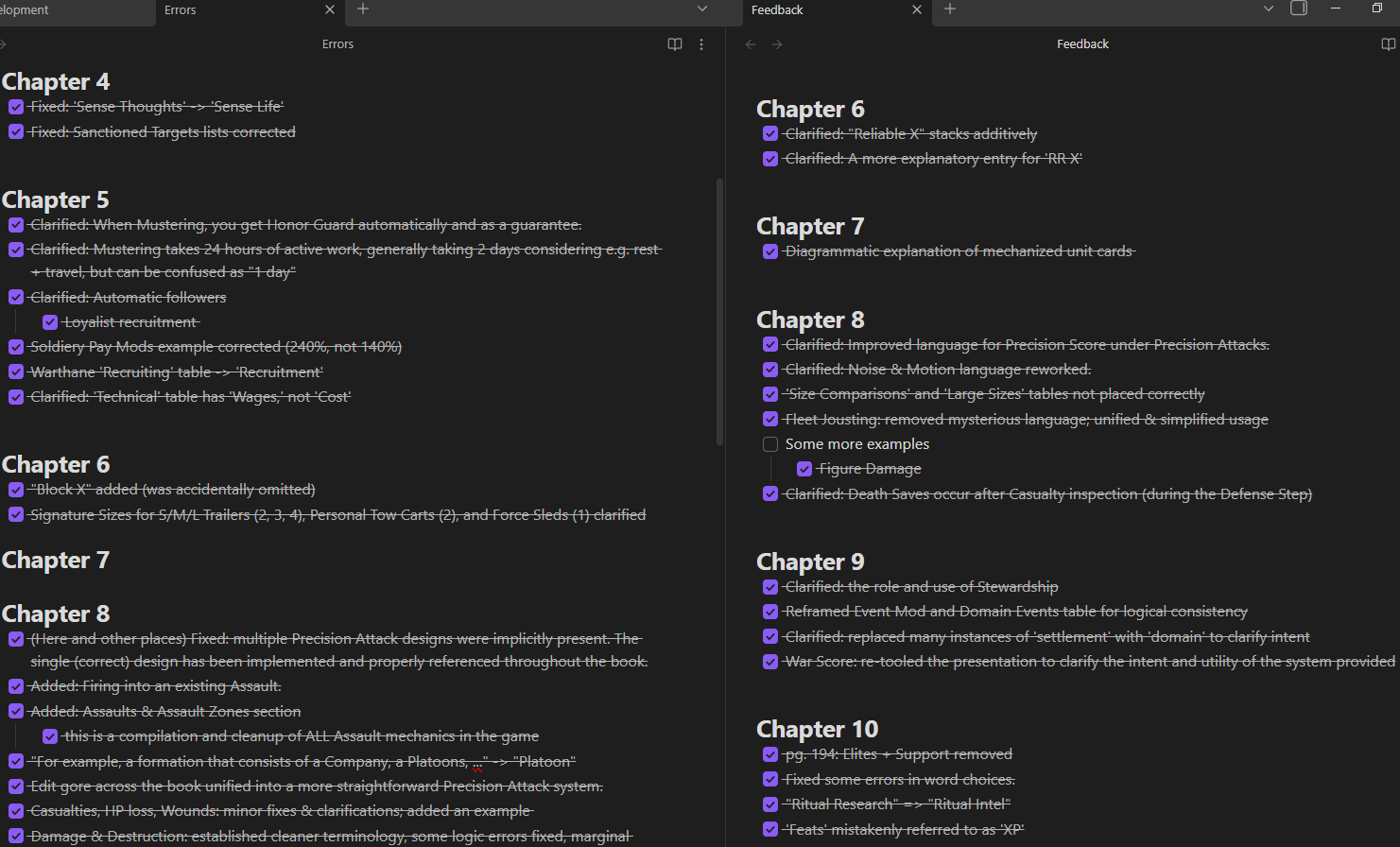
First, it has to be said that several hundred minor points were fixed. Individually, these don’t have much of an impact, but the collective effect is a more refreshing reading experience, with points of confusion pivoted into clarifying guides.
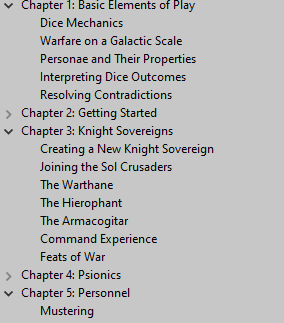
There are now something like 120 properly tiered bookmarks, with one for each major section. Navigating the book on electronic devices should be lightning-fast now, and the speed and ease of referencing should be dramatically increased.
But the biggest improvements were those which addressed targeted systems. Many of these required some difficult playtesting for sanity testing, quality assurance, and harmoniousness with the rest of the rules. Because BMD is intended to be a True Contender RPG, rewriting + hoping isn’t good enough!
Assault System
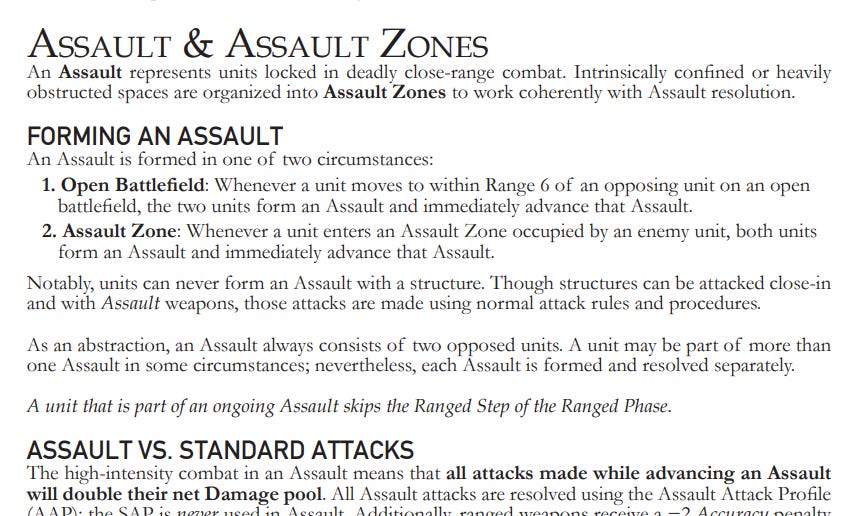
In BMD combat, there are two basic modes of attack. Standard Attacks are the most common and ordinary; lighting up foes at range is the bread-and-butter of BMD’s far-future warfare gameplay. On the other hand, Assault Attacks are for units locked in close-range combat with a foe. The key components of Assault Attacks are:
they happen in close quarters
the Damage is doubled!
But it goes far beyond this, of course. Some locations, such as structure & ship interiors, cave systems, or dense wildlands are intrinsically confined or heavily obstructed spaces. ALL attacks in these spaces are, by necessity, Assault Attacks. An Assault Zone is an abstraction designed exactly to describe these places so they’re fit for gameplay. Assault Zones have their own separate styles of movement, line-of-sight, and other characteristic behaviors one would expect.
The problem was: these considerations glue a hundred disparate things together! They were originally spread out through the rulebook with contextually placed explanations or definitions—but that was confusing. Beyond this, there were many subtle questions left unanswered even by the full conglomeration of the rules. The fix to this was to remove the scattered rules and unify them into one logical place in the Systems of Resolution chapter.
Precision Attacks
At Primeval Patterns, we have no shortage of skepticism towards modern game design principles. Many of the “achievements” of modern game design represent a flattening of a rich space of decisions, the destruction of satisfying complex forms in favor of artistic expression or a perverse devotion to aesthetic simplification, or even just Plain Bad Advice.
There is a certain mechanistic mindset that conceptualizes, ambiguously, the path to perfection through successive refinement. This mindset instinctively latches onto concepts like “Iterative Design,” as a solution-seeking method, rather than an ex post facto transfiguration of the observation “testing leads to insights” into a rule. The Precision Attack suffered, perhaps predictably, from this exact “Iterative Design” approach.
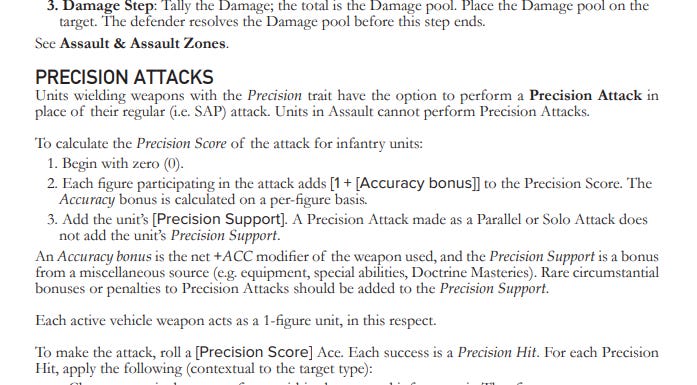
In BMD, the Precision Attack is a special option available with certain weapons. It is meant to be an avenue for precision marksmanship and acts, mechanically, as a means of bypassing high Protection values to cause Wounds directly instead of as the result of Damage. In the beginning stages of the game’s testing, the Precision Attack design went through a number of stages before requiring a holistic redesign prior to the release of First Blood. Unfortunately, much of the cruft from previous designs still lived spread all around the book. Even worse, some of those were reference points used to implement and describe the final envisioned design! What a mess!
But now, Precision Attacks are explained in great detail and clarity in a small section under “Attacks” in the Systems of Resolution chapter. Improper references to old designs have been removed, and the terminology has been updated across the rulebook to form a clean conceptual boundary.
Unit Cards and Clarity
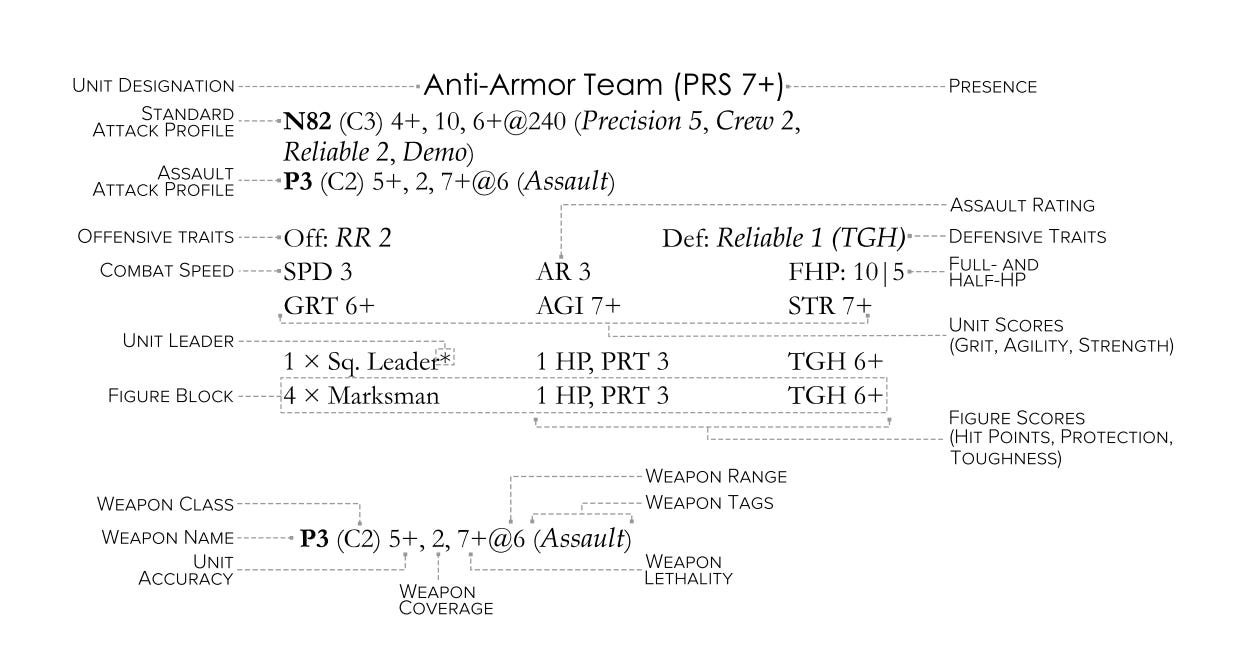
Typical BMD gameplay involves a lot of forces compared to other RPG examples. With exceptions, the bulk of these forces are easy to understand, but new players will find their makeup and presentation unfamiliar. The optimal way to execute BMD gameplay, with far beyond 1000+ hours of testing, is with units organized in read-and-roll fashion on a card. The unit cards in the book are designed to mimic a 3" × 5" note card, which is the easy, accessible way to record units for practical use.
However, most RPG players are used to presentations like character sheets with detailed items of account and spaces to write every conceivable thing they might need to know. This kind of “character sheet” in BMD would be of little use. Rather, a player needs to know contextually about:
his Knight Sovereign character
a few attributes, rank, traits, and ISC
the number & variety of his followers
some have traits (more with Warthane)
almost all have the same stat line
his listing of assets (equipment & vehicles owned or leased)
his current progress on various measures
tracking to qualify for War Feats (alien casualties, quantities of Intel etc.)
tracking for some class-based campaign activities
That’s an overwhelming number of things to know! In fact, even if one could hold all that in mind or on hand, it does not properly equip them for efficient gameplay! And because this problem is predictable and intrinsic to the desired form of play, we intentionally designed the game’s information structure so that only a small fraction of this is ever relevant at any one time.
This is where unit cards come in. We look at our followers, consider their number and the equipment available, and organize them into a well-defined composition—a set of units. This combined collective of units is, in game terminology, a battlegroup. Battlegroups compose additively; two can combine their forces into one battlegroup, or split into multiple battlegroups, or mix and match, or so on.
Functionally, a battlegroup is just a stack of unit cards—the unit cards are everything you need to know about a battlegroup! To help ease players into this method of organization, we have included some additional explanation, improved clarity on minor points, and two new unit diagrams detailing the anatomy of unit cards.
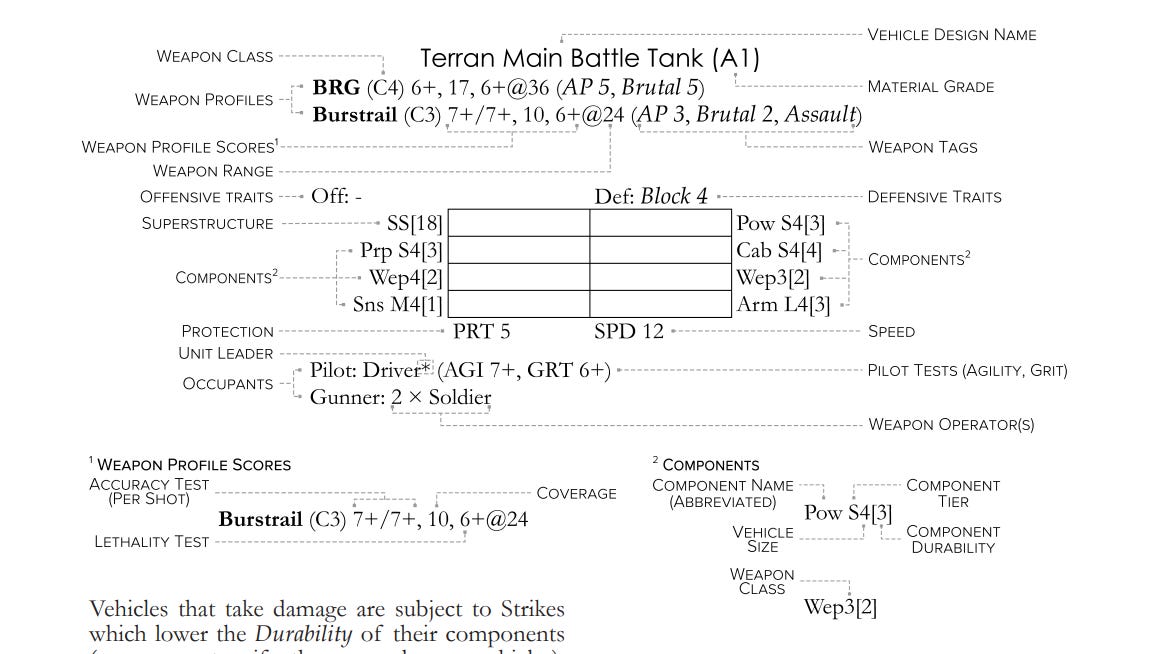
Because vehicles behave in a mechanically different manner, the design of their unit cards is similar but distinct. In practice, we have found that including whitespaces to mark off damage to components makes vehicle tracking at-a-glance dramatically easier—we recommend copying this design to your unit cards.
Signature Size
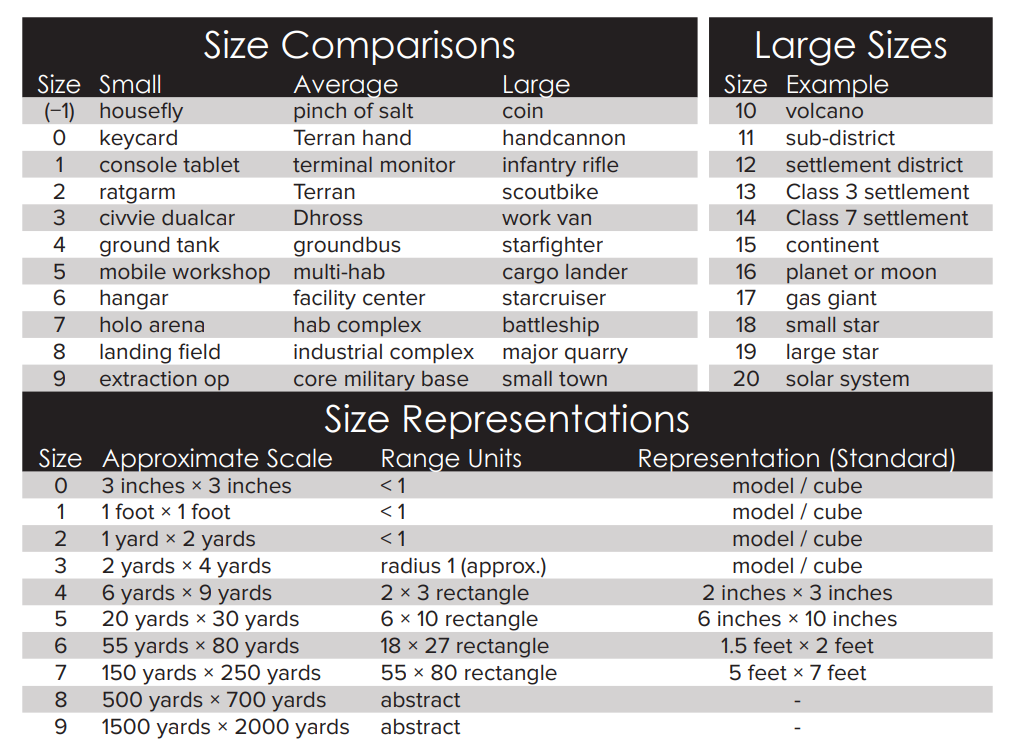
Recently, we made a series of twitter threads1 about Signature Size in BMD. To put it simply, Signature Size (or Size) is a scale translation mechanism in the game. Do you have a big weapon attacking small targets? Do you have a small weapon attacking a big target? Things that jump across scales all involve the Size parameter.
Because Size was always intended to be a categorical indicator, rather than a strict measure, the approach to its design intentionally left a lot of fuzziness and room for interpretation. Unfortunately, this proved insufficient because recent playtesting showed that some Sizes were “incomplete,” whereas other Sizes had substantial gaps between them, in practice. The most important role of the rulebook is authority, and if players cannot come to “agree” on what they imagine, that is a clear failure.
Several of the Size categories have been tweaked, and the “Large” Sizes have been retooled. In addition, the difficult decision has been made to include explicit guidance on Sizes with respect to their literal representation in the gameworld, as well as their corresponding representations at the table. This, we hope, should settle many questions that come up about Size during play, as well as aiding visualization of imagined events and objects.
Noise & Motion
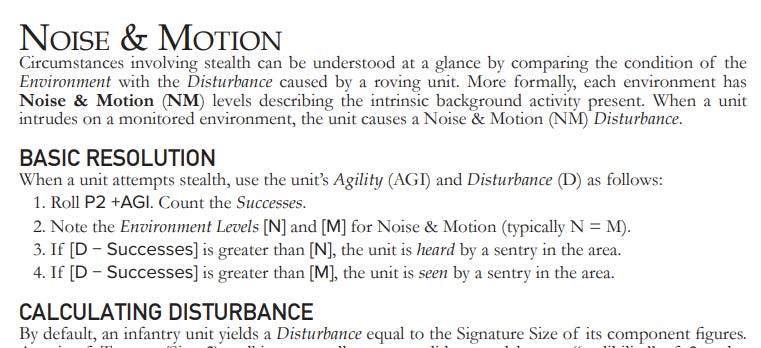
If the Signature Size system is there to aid players in understanding the scale of effects they encounter in the gameworld, the Noise & Motion system is there primarily to help them understand the relationship between ambience and the disturbances that would interrupt it.
Simply put, this system was written in a way that caused confusion. It has been carefully rewritten, with exactly the same functionality as previously, in a more intuitive way that should be easier to discuss without causing confusion or doubt.
Honorable Mentions
The War Score system received some additions, clarity, and support. This system has worked well in playtests, but its benefits are not easy to convey. Contests over territory involve a great many factors that are not (directly) present in the game rules; on the other hand, it is often the case that extensive conflicts end far too early (player morale fails) or far too late (player insists on fighting ‘to the death’).
To address both of these issues simultaneously, the War Score system takes player-directed action and frames it into a larger (implied) whole of theater-wide support. A battle may seem quaint to those who fought it, but that battle can end up being the essential dam-breaker for ultimate victory, on reflection. Similarly, life-defining struggles are sometimes forgotten or ignored by the larger public, or even by the men at desks forcing them to happen. The War Score system invites this perspective into the game in a way that does not weigh each battle down in systems of reflection.
For other notable fixes, we had several obnoxious ambiguities and omissions. For example, Mustering Honor Guard was not explicitly explained, requiring the player to think (and understand) far too much, especially if they are unfamiliar with the game! The first ever keyword introduced to the game, Block X, was omitted entirely from the list of traits; the wages of familiarity!
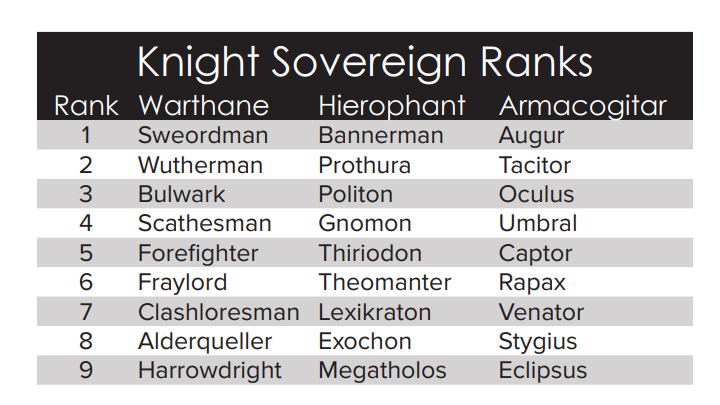
On a less functional and more aesthetic note, the classes now have individual titles at each Infamy Rank, rather than a set of titles that span across two or more ranks. We leaned into different language groups (apart from “Bannerman”) for each class to further establish their in-world roles and expectations.
What to Expect Next
As it stands, there are several mission-critical items not yet incorporated into BMD, namely:
Uncharted Systems & their associated encounters and effects
Expanded deep space logistics and encounters
Space Stations
Large Vehicle & Structure representation
Appendices
In-house testing is already under way on a promising candidate design to capture 3. and 4. with an easy-to-use framework. If things shake out as expected, this “cluster” framework will find its way into the next revision.
Uncharted Systems + expanded deep space logistics are on a similar footing with respect to harmonizing their content with the game as a whole.
The Appendices are, for the most part, merely incomplete and disorganized. Playtesting will carve this out, but we are also compiling a thorough “Appendix N” of supporting literature, as well as considering some important historical works and even field manuals and treatises which were relevant in the game’s development.
A War is Coming
Terran civilization lies defeated. The demonic alien prowls the galaxy for survivors, enslaving them to his will while he plots his next betrayal. But YOU, Divinely blessed child of Terra, can put a stop to it right now! Take up your sword and fight.
Thank you for your readership! Primeval Patterns thrives on the basis of the sincere interest and support of hobbyists like you.
Liked the article? Some other interesting things:
Follow the author on X.com (formerly twitter).
Check out BMD, a far-future wargame-infused TTRPG about slaughtering aliens.
Think carefully when designing or using skill systems!
Understand starting an ACKS campaign from scratch.
With work, we can achieve TTRPG Supremacy!
If you are a true fanatic, take the oath of battle and become a paid subscriber here on Substack. This directly supports the war effort (and the development of BMD plus the design research on this blog.)
BONUS: paid subscribers can read extensive BMD development blogs and are entitled to a PDF copy of BMD!